


Summer Cruising in Arctic Ice Fields: Lessons From Vanguard’s Explorer Yacht Journey
Updated: Feb 16
A first‑hand account of navigating Greenland and Svalbard with two of the Arctic’s most experienced ice pilots.

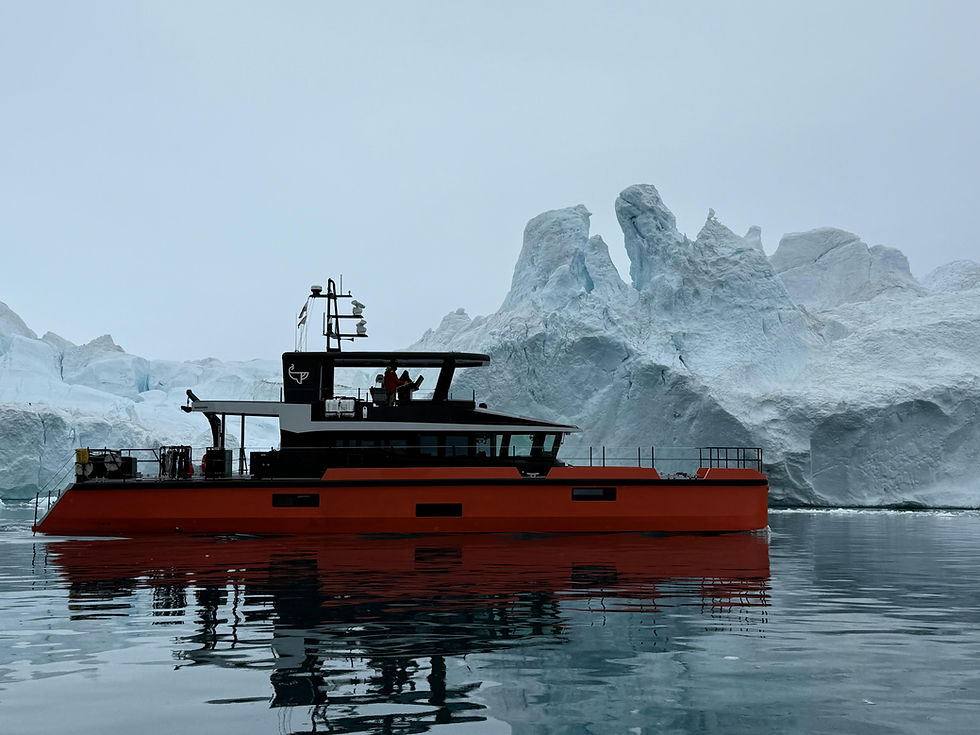
This summer aboard the Vanguard Explorer Yacht, we had the privilege of sailing with two remarkable ice pilots, Nick Weis‑Fogh and Torill Estella Pfaff. They spend their lives navigating the high Arctic, from Svalbard to West Greenland, and their knowledge transformed our voyage from a risky experiment into a safe, humbling education.
Their guidance exposed us to aspects of Arctic navigation we would never have understood on our own. These are the practical, uncomfortable, and sometimes surprising lessons we learned from cruising in one of the most unforgiving environments on earth.
Living in the Arctic
Life aboard an explorer yacht in Greenland is simple, raw, and completely dependent on preparation.
Refrigeration becomes optional — eggs, milk, beer, and wine stay cold outdoors even in midsummer.
Provisioning ashore is limited — bring everything you need; local stores are basic.
Fishing is practical — Arctic char is easily caught with a gill net (retrieve it with a broom handle or it will tangle).
Fjord cod are parasite‑ridden — paleoecological cod are a better target.
There is no night — 24‑hour daylight turns every hour into a passage opportunity.
Local hospitality is genuine — Nova Scotia, Newfoundland, Labrador, and Greenland communities welcome strangers warmly.
Take time to drift, to watch the scenery, to understand the people. The Arctic rewards patience.
Anchoring in Ice Waters
Anchoring in Greenland is equal parts seamanship and improvisation.
Large bergs cannot enter shallow water — use depth as protection.
Small bergs drift with wind and current — push them away with a long pole (never while underway).
Avoid kelp beds — they foul anchors and are difficult to clear.
Look for anchorages near moraines or stream outflows — kelp avoids brackish water.
Charts are vague or nonexistent — rely on sonar and slow movement.
Estimate depth as 6–8 times the visible height of a berg.
Seabeds are often bedrock — finding good holding takes time.
In the Arctic, anchoring is not routine. It’s strategy.
Weather: Unpredictable and Unforgiving
Greenland’s weather is hyper‑local and changes without warning.
Increase scope significantly in bad weather.
Keep engines on standby in tight anchorages.
Sudden wind shifts can unseat even a well‑set anchor.
Expect sleet, snow, and freezing seas even in midsummer.
A reliable heater is essential.
Forecasts help, but instinct and preparation matter more.
Navigation in Ice Fields

Navigation in Arctic ice is slow, deliberate, and deeply humbling.
Ice fields may look impenetrable — but patient searching reveals leads.
Steering is ineffective at low speed — rely on thrusters and pulsing water across rudders.
Fog often reduces visibility to 100 meters — eyesight and radar are critical.
Growlers and bergy bits are massive underwater — avoid contact entirely.
Pass large bergs on the upwind side to avoid growlers.
Melting ice hisses like snakes — trapped ancient air escaping.
Bergs can roll or collapse — stay at least one berg‑height away.
Transparent ice is nearly invisible — watch water behavior for clues.
Inuit fishermen know these waters better than any chart — follow their lead.
The hull is not a battering ram. Respect the ice.


Key Lessons Learned
Respect the ice — even “small” bergs weigh thousands of tons.
Local expertise is priceless — Nick and Estella’s guidance made the voyage possible.
Judgment matters more than equipment — knowing when to wait, push, or turn back is the ultimate skill.
The Arctic teaches quickly or painfully.

Why This Matters for Explorer Yacht Owners
Arctic cruising demands preparation, humility, and experience
Vanguard’s journey reflects the realities owners must understand
This is not aspirational cruising; it’s operational reality
That distinction is what defines true explorer yachts
No sales pitch. Just authority.

an amazing experience
Excellent, sage advice, Chris. I am definitely envious.